Alaskan Resources

The Department of Education & Early Development has created a comparison tool for to support the transition to the new standards. This tool can be used to assist educators in analyzing the commonalities and differences between the new standards and the Fourth Edition reading, writing, and mathematics standards (Grade Level Expectations).. This tool is a start toward the transition, and districts may choose to augment the document with more detail. All districts will continue to administer the Standards Based Assessments, which are aligned to.....
Assessment Resources
Tools to Transition to the New Alaska Standards
The Department of Education & Early Development has created a comparison tool for to support the transition to the new standards. This tool can be used to assist educators in analyzing the commonalities and differences between the new standards and the Fourth Edition reading, writing, and mathematics standards (Grade Level Expectations).. This tool is a start toward the transition, and districts may choose to augment the document with more detail. All districts will continue to administer the Standards Based Assessments, which are aligned to.....
Alaska State Literacy Blueprint-Birth To Graduation

The Blueprint was created by the Alaska Department of Education & Early Development and a State Literacy Team of Alaskan educators, to focus on the development of children's literacy from birth to graduation. The Blueprint is intended to provide guidance to policymakers, districts, school and community leaders, educators and families about ways to support all children in becoming literate and prepared to fully participate in their chosen.....
New Alaska Standards
Driven by a desire to better prepare graduates for college and careers, the department with the support of Alaska educators and stakeholders has revised the English Language Arts and Mathematics Standards to adequately prepare Alaskan students to compete globally. The Standards were adopted June 2012.
eLearning Module from EED: Alaska Steps Toward Educational Progress and Partnership (STEPP)
This course is for school and district staff participating in Alaska STEPP. The course is organized into 17 chapters. The first chapter is an overview of the purpose and process of Alaska STEPP. The remaining 16 chapters outline other specific details in navigating STEPP and applying it to the School and District Improvement process.
1. To access this course, you must first login as a user at www.eed.state.ak.us/ELearning/
2. After successfully logging in, you will see a Welcome page. On the right hand side of the page is a link for.....
CAI Institute Resources - Formative and Common Assessments - Nov 8/9, 2010


Julia Payne-Lewis from Measured Progress was the presenter for these sessions. Her focus was on developing an understanding of effective strategies for applying GLEs, competencies and learning targets to the development and use of Common Formative Assessments.
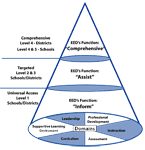
Alaska State System of Support (SSOS) Operations Manual 2011-2012
Alaska State System of Support (SSOS) Operations Manual,
Building Local Capacity, 2011-2012
The Alaska SSOS's mission is to support districts as they build their capacity to implement sustainable school improvement strategies with fidelity. Authority for developing and implementing a system of support for districts and schools comes from both State and Federal law. This document provides an overview of the SSOS program and resources that are available to districts and schools in Alaska.
Alaska Self-Study Tool
The Self-Study Tool (SST) was developed to help schools conduct an internal review as part of their school improvement effort. The SST materials are based on the Instructional Audit Tool that has been used throughout Alaska to conduct on-site school audits by external teams of educators. The SST process provides teams from a school community an opportunity to engage in discussion and evidence-based inquiry. It is not intended to be the basis for evaluation or for making comparisons across schools. The end product is not a score, but the.....
State of Alaska Standards, GLE's, and Formative Assessment
This links to the State of Alaska "Standards" web page which contains the AK Content and Performance Standards, GLE's, Formative Assessments, and more important information related to AK State Standards and Performance.
Alaska Computerized Formative Assessments (ACFA)
ACFA are computer-based formative assessments using the CAL online computer test delivery and reporting system. Items are linked to specific Alaska content standards and grade level expectations (GLEs) in reading and mathematics for grades 3-10. Effective January 13, 2012, the ACFA program was discontinued. If an Alaska school or district is interested in contracting for continued access to ACFA, please contact CAL at 866-406-3850 x125 or [email protected].
(DIASA) DATA INTERACTION FOR ALASKA STUDENT ASSESSMENTS
This site provides dynamic access to student performance results of Alaska Student Assessments. The system allows schools and districts to create their own reports, graphs, and data files for analysis. Building administrators can contact District Test Coordinators for sign in and access information.
Alaska Career Ready Program
The foundational workplace skills of Applied Math, Reading for Information, and Locating Information can become a common language among employers, job seekers, students, and educators. Alaskans may now earn a portable skills credential that documents their skill levels in these three important foundational skills that are important in virtually all occupations, colleges, and training programs.
Whether you are a student, a parent, an employer, a job seeker, a teacher, or a career guidance counselor, Alaska Career Ready is for you!
Publications for Alaska Standards for Culturally Responsive Schools
The following standards have been developed by Alaska Native educators to provide a way for schools and communities to examine the extent to which they are attending to the educational and cultural well being of the students in their care. These "cultural standards" are predicated on the belief that a firm grounding in the heritage language and culture indigenous to a particular place is a fundamental prerequisite for the development of culturally-healthy students and communities associated with that place, and thus is an essential ingredient.....