Research and Best Practices


This two part rubric and worksheet is for use by individuals responsible for monitoring (1) district-level capacity to support response to intervention (RTI implementation and (2) district-wide fidelity of RTI implementation.
Assessment Resources
Screening for Mathematics Difficulties in K-3 Students - Second Edition
This second edition of Screening for Mathematics Difficulties in K-3 Students which was originally published in 2007 updates the document with new research in the assessment field in developing valid and reliable screening measures for early mathematics difficulties. It focuses on valid and reliable screening measures for students in kindergarten and first grade but also examines data on screening tests for second and third graders, since the goal of screening is to identify students who might struggle to learn mathematics during their initial.....
eLearning Module from EED: Alaska Steps Toward Educational Progress and Partnership (STEPP)
This course is for school and district staff participating in Alaska STEPP. The course is organized into 17 chapters. The first chapter is an overview of the purpose and process of Alaska STEPP. The remaining 16 chapters outline other specific details in navigating STEPP and applying it to the School and District Improvement process.
1. To access this course, you must first login as a user at www.eed.state.ak.us/ELearning/
2. After successfully logging in, you will see a Welcome page. On the right hand side of the page is a link for.....
The English Language Learner KnowledgeBase
This English Language Learner KnowledgeBase website is an online database of resources supporting education professionals in the administration of programs and instruction for ELLs. Its resources are identified for four categories of users: Program Administrators, Teachers, Parent Advocates, and Educators of Migrant Students.
This resource pertains to the following topics:
English Language Learning
Special Populations
Research: Meta-analyses and Summaries
Practitioner Guides
PD Modules and Training Materials.....
Key Considerations When Measuring Teacher Effectiveness: A Framework for Validating Teachers’ Professional Practices
The report describes three levels of data collection to measure teacher effectiveness both with and without standardized test scores.
Find What Works

Looking for a better way to find curricula, products, and practices that meet your school or district's needs? Check out the new and improved What Works Clearinghouse (WWC) search feature, Find What Works. This powerful tool makes it easy to find out what rigorous research says about the effectiveness of more than 100 widely used education interventions. You can search for interventions by grade level, subject, delivery method, and other.....
The Complex Ecology of Response to Intervention
This document contains papers presented by the National Center on Response to Intervention at a structured poster session, “The Complex Ecology of Response to Intervention,” at the American Educational Research Association (AERA) 2010 Annual Meeting in Denver, CO. The topics covered include 1. information on the overall RTI framework, 2. screening and progress monitoring within RTI, 3. delivery of instructional interventions within a RTI system, 4. SLD identification and RTI, 5. implementation of RTI across states, and 6. RTI as.....
Updated Progress Monitoring Tools Chart (National Center on RTI)
The National Center on Response to Intervention announces the updated release of the Progress Monitoring Tools Chart! This chart represents the results of the third annual review of progress monitoring tools by the Center’s Technical Review Committee (TRC).
The chart provides ratings on the technical adequacy of progress monitoring tools used within an RTI context. The tools were rated against standards of general outcome measures, or mastery measures. Additional information on how to implement the tools can be found on the chart as well......
Progress Monitoring for Elementary Mathematics (COI)
This PowerPoint presentation from the November 2006 Math Summit: Providing Evidence-Based Practices and Implications of NCTM Focal Points provides an overview of progress monitoring systems that can be used to track student growth in elementary mathematics.
A Comprehensive K-3 Reading Assessment Plan: Guidance for School Leaders (COI)
Because scientific studies have repeatedly demonstrated the value of regularly assessing reading progress, a comprehensive assessment plan is a critical element of an effective school-level plan for preventing reading difficulties. This guide from the Center on Instruction provides valuable information for school leaders. While the general principles, such as the early identification of students who are struggling in learning to read, are all based on scientific findings, the detailed recommendations for implementation derive from practical.....
Assessments to Guide Adolescent Literacy Instruction (COI)
This guide from the Center on Instruction is a companion volume to two other COI publications: Academic Literacy Instruction for Adolescents and Improving Literacy Instruction in Middle and High Schools: A Guide for Principals. It provides information about the key elements of a comprehensive assessment plan to improve literacy instruction for adolescents and provides examples of assessments and assessment systems currently in use or under development to improve literacy instruction for students in grades 4-12.
New Functionality for the Screening, Progress Monitoring, and Instruction Tools Charts
The National Center on Response to Intervention is pleased to announce that the Screening, Progress Monitoring, and Instruction tools charts have been updated to include new functionality . You are now able to sort all columns by clicking the arrow at the top of each column, filter by subject (math, reading, writing) and by grade level (elementary and secondary), and compare a select group of tools by checking the box on the far right. Many features and the content of the chart remain the same, but this new functionality will help you to find.....
The Essential Components: Multi-Level Prevention System (Webinar)
As one in a series of webinars focused on the essential components of RTI, this month’s webinar provides information on the primary, secondary, and tertiary levels of prevention. Dr. Katie Tackett provides an overview of primary, secondary, and tertiary levels of prevention, the types of instruction and assessments at each level, where the instruction typically occurs, and the instructional decisions that can be made based on data.
Follow-up Live Online Chat
Please join a live online chat focused on “The Essential Components of RTI:.....
National RTI " Responder Monthly Newsletter"
This link takes you to the monthly newsletter from the National RTI Center. It highlights topics of both national and statewide interest related to response to intervention practices, including resources from the USDOE website "Doing What Works." Educators can sign up to receive this newsletter through their personal email accounts.
Response to Intervention in Elementary-Middle Math
This multimedia overview explains why states and districts are turning to Response to Intervention (RtI) systems described, including the three instructional tiers and components that are common to most systems. Each sub-section contains a practice summary along with practice help: Learn What Works (video interviews with nationally known research experts), See What Works (slideshows with audio of successful schools that have implemented RTI), and Do What Works (ideas for action and tools and templates).
This resource pertains to K-8 math.....
Response to Intervention in Primary Grade Reading
Response to Intervention (RTI) in Primary Grade Reading is one of four sections within the newly added Data-Driven Improvement area on the Doing What Works website. The section is divided into four sub-sections: Universal Screening, Progress Monitoring and Differentiation, Systematic Skill Instruction, and Response to Intervention. Each sub-section contains a practice summary along with practical help in three tabs: Learn What Works (video interviews with nationally known research experts, key concepts, research evidence, and related links),.....
Data Use for Improving Learning Re-launched (Assessment & Accountability Comprehensive Center)
“An increasing body of evidence points to the link between effective data use and student learning,” said Margaret Heritage who managed the comprehensive revisions. She noted that the “Race to the Top” program goals place a high priority on better data systems that inform schools and teachers.
The new site includes a data users guide plus specific examples from states, school districts, and schools of successful data use. This site also has components of formative and diagnostic assessment.
Uncharted Territory: Using Tiered Intervention to Improve High School Performance
A new report from the High School Tiered Interventions Initiative (HSTII), a collaboration among the National High School Center, the Center on Instruction, and the National Center on Response to Intervention, summarizes what HSTII has learned thus far about effective implementation of RTI in high schools.
Tiered Interventions in High Schools: Using Preliminary ‘Lessons Learned’ to Guide Ongoing Discussion, provides a brief description of the RTI framework and the essential components of RTI, illustrates how the essential components of.....
Alaska State System of Support (SSOS) Operations Manual 2011-2012

Alaska State System of Support (SSOS) Operations Manual,
Building Local Capacity, 2011-2012
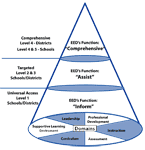
The Alaska SSOS's mission is to support districts as they build their capacity to implement sustainable school improvement strategies with fidelity. Authority for developing and implementing a system of support for districts and schools comes from both State and Federal law. This document provides an overview of the SSOS program and resources that are available to districts and schools in Alaska.