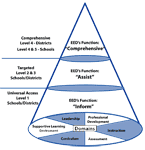
The Alaska Department of Education & Early Development provided training for district-based teams in Alaska in the implementation of effective curriculum management strategies. The institute helped districts in identifying next steps toward having manageable, locally informed, and efficiently-operating curriculum practices.
The listed materials are provided by facilitator Susan McCauley, PhD, and are available for download.
The Alaska Department of Education & Early Development has provided training for district-based teams in Alaska in the implementation of effective curriculum management strategies. The resources listed above are from the November 9 and 10 Institute in Anchorage

The Blueprint was created by the Alaska Department of Education & Early Development and a State Literacy Team of Alaskan educators, to focus on the development of children's literacy from birth to graduation. The Blueprint is intended to provide guidance to policymakers, districts, school and community leaders, educators and families about ways to support all children in becoming literate and prepared to fully participate in their chosen.....
Driven by a desire to better prepare graduates for college and careers, the department with the support of Alaska educators and stakeholders has revised the English Language Arts and Mathematics Standards to adequately prepare Alaskan students to compete globally. The Standards were adopted June 2012.
This course is for school and district staff participating in Alaska STEPP. The course is organized into 17 chapters. The first chapter is an overview of the purpose and process of Alaska STEPP. The remaining 16 chapters outline other specific details in navigating STEPP and applying it to the School and District Improvement process.
1. To access this course, you must first login as a user at www.eed.state.ak.us/ELearning/
2. After successfully logging in, you will see a Welcome page. On the right hand side of the page is a link for.....
These powerpoints were use by Ben Jones, Director of Research & Development for
The Standards Company - www.standardsco.com
Introduction to the Enacted Curriculum, Part A - This powerpoint is from the first session. In this session, we will discuss some of the basic terminology used to investigate the Enacted Curriculum and set the stage for deeper.....
The Alaska Arts Education Consortium (AAEC) is an affiliation of school districts, organizations and individuals committed to preparing and supporting educators so that they can teach the arts across the curriculum.
Mission Statement
Their mission is to promote high achievement for all Alaskan students in and through the arts by:
* Creating and sustaining communication networks
* Initiating and strengthening community partnerships
* Preparing and supporting educators through professional development.
The National Archives has launched a new online tool for teaching with documents. Not only does DocsTeach.org welcome educators to explore thousands of documents in a variety of media from the holdings of the National Archives, but it also allows teachers to combine these materials using clever tools to create engaging activities. Teachers can create lessons from scratch, adapt lessons from others, or let their students create the lessons, and a single suite of tools can be applied to a range of subjects and skill levels. FOR MORE.....
"Content standards" are broad statements of what students should know and be able to do as a result of their public school experience. In addition to providing "meaningful opportunities" for students in state assessed reading, writing, mathematics, and science standards, districts are expected to provide "meaningful exposure" to content standards not tested by the state so that students receive a balanced education. The concept of meaningful exposure comes from a ruling by Judge Gleason in Moore v State of Alaska.
Alaska State System of Support (SSOS) Operations Manual,
Building Local Capacity, 2011-2012
The Alaska SSOS's mission is to support districts as they build their capacity to implement sustainable school improvement strategies with fidelity. Authority for developing and implementing a system of support for districts and schools comes from both State and Federal law. This document provides an overview of the SSOS program and resources that are available to districts and schools in Alaska.
The Alaska Native Knowledge Network (ANKN) is an AKRSI partner designed to serve as a resource for compiling and exchanging information related to Alaska Native knowledge systems and ways of knowing. It has been established to assist Native people, government agencies, educators and the general public in gaining access to the knowledge base that Alaska Natives have acquired through cumulative experience over millennia. Anyone wishing to participate in the Alaska Native Knowledge Network or contribute to the development of the resources in this.....
The Department of Education & Early Development asked the Alaska Comprehensive Center and Education Northwest to collect up-to-date information on reading and mathematics curricula, including texts and other published materials, that each district has adopted/purchased. It was EED’s intention by means of this survey to provide information to districts regarding curricula in use in the state and the ways districts are aligning the curricula to the standards.
The Self-Study Tool (SST) was developed to help schools conduct an internal review as part of their school improvement effort. The SST materials are based on the Instructional Audit Tool that has been used throughout Alaska to conduct on-site school audits by external teams of educators. The SST process provides teams from a school community an opportunity to engage in discussion and evidence-based inquiry. It is not intended to be the basis for evaluation or for making comparisons across schools. The end product is not a score, but the.....
Teachers should provide explicit vocabulary instruction both as part of reading and language arts classes and as part of content area classes such as science and social studies. Learning specialized vocabularies contributes to the success of reading among adolescent students. By giving students explicit instruction in vocabulary, content area teachers help them learn the meaning of new words and strengthen their independent skills in constructing the meaning of text.
If participation in career and technical education has some relationship to dropping out of high school, we need to understand the nature of this relationship better. Research in this area can have implications for our conceptual understanding of what helps students find attachment to high school. Additionally, research in this area could have policy or practical implications for secondary education, as decisions are made about where dollars should be invested and how curriculum should be organized.
After considering simple descriptive.....
Dual enrollment programs enable high school students to enroll in college courses and earn college credit. Once limited to high-achieving students, such programs are increasingly seen as a means to support the postsecondary preparation of average-achieving students. Moreover, though dual enrollment programs typically have been reserved for academically-focused students, increasing numbers of career and technical education (CTE) programs are providing such opportunities to their students.
Despite the popularity and growth of dual.....
The Math-in-CTE model is a curriculum integration model designed to enhance mathematics that is embedded in career and technical education (CTE) content. It is a process that provides the opportunity for math and CTE teacher teams to work together in communities of practice and to identify where math intersects with CTE concepts and applications. This process leads to the creation of math-enhanced CTE lessons that follow a seven-element pedagogic framework. Premised on five core principles, the research-based Math-in-CTE model has been shown.....