Research and Best Practices


This two part rubric and worksheet is for use by individuals responsible for monitoring (1) district-level capacity to support response to intervention (RTI implementation and (2) district-wide fidelity of RTI implementation.
High School Resources
Prevent Dropout with an Early Warning System
This resource provides an overview of the Early Warning System tool and process, which is designed to support students who are at risk of dropping out of school with both school-wide strategies and targeted interventions. It provides background information, an implementation guide, and both a high school and middle school tool to identify and monitor students at risk of dropping out of school
Intensive Interventions for Students Struggling in Reading and Mathematics -Practice Guide
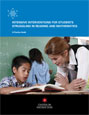 This guide provides research-based guidance that reflects "best practices" for intensifying instruction in reading and mathematics for students with significant learning difficulties in K-12, including students with disabilities. It can also be used as a resource for instructional specialists and special education teachers who are searching for broad guidelines on the design and delivery of intensive interventions.
Improving Adolescent Literacy in Rural Schools: A Schoolwide Approach
This is the second in a series of webinars especially designed to assist rural school staff with implementation of their School Improvement Grants (SIGs).
The intended audience for this webinar includes all educators engaged in or interested in improving literacy instruction for adolescents—grades 6–12. The presenters were Dr. Debby Houston Miller and Vicki LaRock from the Center on Instruction's Literacy Team. During this one hour webinar, presenters focused on the following guiding questions:
What are the major goals of adolescent.....
New! ----High School Knowledge Database
The National High School Center has announced a free new online resource located on the website: High School Knowledge Database. The Database houses vetted resources on a variety of high school improvement topics that can be sorted and filtered, and replaces the static Topics Web pages that previously housed these resources. The new Database includes three search options: 1) a Keyword text search; 2) a High School Topic Area(s) search; and 3) an option to Search by the Eight Elements of High School Improvement. This last search allows you to.....
New Updates to the National High School Center's Early Warning System (EWS) Tool v2.0 and Technical Manual
The National High School Center recently released an updated version of the tool and technical manual to better support users as they strive to identify and address issues that lead to students dropping out of school. The updated tool includes a new Export Data feature, and the updated Technical Manual includes several additional instructions, hints, and cautions to help you use the tool. More details on the new tool and Technical Manual are below, along with instructions on how you can easlily transfer your existing data into the new tool......
COI Webinar Series: Using DWW Resources to Support SIG Grantees in Adolescent Literacy
The Center on Instruction has released a series of five webinar modules designed to provide key adolescent literacy principles and practices to support the federally funded School Improvement Grants (SIG). The webinar modules introduce the Center on Instruction (COI) and Doing What Works (DWW) websites' tools and resources and address 1) school leadership, 2) research overview, 3) explicit vocabulary instruction in middle and high school, 4) text discussion, and 5) intensive interventions for struggling readers. Also included for each module.....
Eight Elements of High School Improvement: A Mapping Framework
from National High School Center at the American Institutes for Research betterhighschools.org
This document offers descriptions of the eight elements of high school improvement:
• Rigorous Curriculum and Instruction
• Teacher Effectiveness and Professional Growth
• Stakeholder Engagement
• Organization and Structure
• Assessment and Accountability
• Student and Family Involvement
• Effective Leadership
• Sustainability
Summer Learning Opportunities in High Poverty Schools
This report profiles five summer Extended Learning Opportunities programs that have contributed to improved student achievement in high-poverty schools.
Assessments to Guide Adolescent Literacy Instruction (COI)
This guide from the Center on Instruction is a companion volume to two other COI publications: Academic Literacy Instruction for Adolescents and Improving Literacy Instruction in Middle and High Schools: A Guide for Principals. It provides information about the key elements of a comprehensive assessment plan to improve literacy instruction for adolescents and provides examples of assessments and assessment systems currently in use or under development to improve literacy instruction for students in grades 4-12.
Adolescent Literacy Walk-through for Principals: A Guide for Instructional Leaders - Grades 4-12 (COI)
This guide and accompanying scenarios of adolescent literacy instruction from the Center on Instruction, designed to help principals monitor and support adolescent literacy instruction in their schools more effectively, can be used at the late elementary school level, in content-area classes in middle and high school, and with intervention groups or classes. It provides a scaffold to build principals' understanding of scientifically based reading instruction, as a means for a principal to gather information about the quality of literacy and.....
The Teachers Page - The Library of Congress
This rich website from the Library of Congress contains ready-to-use materials that bring the Library’s primary sources into the classroom. In addition, it builds teacher skills with the Library's professional development curriculum.
Educators can find classroom materials, professional development activities, Teaching with Primary Sources partners, news and events, class starters, teacher updates, and more Library of Congress resources.
Uncharted Territory: Using Tiered Intervention to Improve High School Performance
A new report from the High School Tiered Interventions Initiative (HSTII), a collaboration among the National High School Center, the Center on Instruction, and the National Center on Response to Intervention, summarizes what HSTII has learned thus far about effective implementation of RTI in high schools.
Tiered Interventions in High Schools: Using Preliminary ‘Lessons Learned’ to Guide Ongoing Discussion, provides a brief description of the RTI framework and the essential components of RTI, illustrates how the essential components of.....
Reinventing the American High School (Association for Career and Tech Ed)
In this paper, the Association for Career and Technical Education review the challenges and current efforts in high school redesign, and offer a number of recommendations about what elements should be included in our mutual efforts to reinvent the American high school for the 21st century.
How the EBIS/RTI Process Works in Secondary Schools
This document developed by the Tigard-Tualatin School District in Tigard, OR includes information on EBIS (Effective Behavior and Instructional Support) as a structured, systematic process (1) to review school-wide behavior and academic data in order to evaluate the effectiveness of core programs, (2) to screen and identify students needing additional academic and/or behavior support, and (3) to plan, implement, and modify interventions for these students. The document can be downloaded below, or you can click here for more information.
IDEA Partnership Collection (K-12 Special Education resource)
A Partnership Collection, a website developed by the IDEA Partnership, is the result of the collaborative work of 65 partner organization representatives, five technical assistance providers, and a number of state and local organizations and agencies representing a range of roles at all levels of the education system and geographic locations across the country. The Collection provides access to a comprehensive database of materials and resources to assist in the understanding of RTI processes and best practices for its implementation on all.....
Individual Learning Plans For High School Students
The information provided addresses the origins and effectiveness of Individual Learning Plans (ILP) for all high school students. Although the use of ILPs may build upon the well established Individual Education Plan (IEP) for students with learning disabilities, it is not explicitly linked to that practice in the resources reviewed.
The use of Individual Learning Plans for all high school students appears to be based on the move towards creating more student-centered, personalized learning environments with one key goal to foster student.....
Explicit vocabulary instruction and strategies that help students become independent vocabulary learners
Teachers should provide explicit vocabulary instruction both as part of reading and language arts classes and as part of content area classes such as science and social studies. Learning specialized vocabularies contributes to the success of reading among adolescent students. By giving students explicit instruction in vocabulary, content area teachers help them learn the meaning of new words and strengthen their independent skills in constructing the meaning of text.
CTE and Possible Links to Dropping Out (National Research Center for Career and Tech Ed)
If participation in career and technical education has some relationship to dropping out of high school, we need to understand the nature of this relationship better. Research in this area can have implications for our conceptual understanding of what helps students find attachment to high school. Additionally, research in this area could have policy or practical implications for secondary education, as decisions are made about where dollars should be invested and how curriculum should be organized.
After considering simple descriptive.....