Research and Best Practices


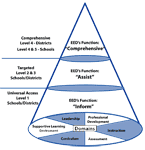
This two part rubric and worksheet is for use by individuals responsible for monitoring (1) district-level capacity to support response to intervention (RTI implementation and (2) district-wide fidelity of RTI implementation.
Middle Level Resources
Intensive Interventions for Students Struggling in Reading and Mathematics -Practice Guide
 This guide provides research-based guidance that reflects "best practices" for intensifying instruction in reading and mathematics for students with significant learning difficulties in K-12, including students with disabilities. It can also be used as a resource for instructional specialists and special education teachers who are searching for broad guidelines on the design and delivery of intensive interventions.
Early Warning System Middle Grades Tool
The National High School Center's Early Warning System (EWS) Middle Grades Tool enables schools and districts to identify students who may be at risk for academic failure and to monitor these students’ responses to interventions. The tool relies on student level data available at the school or district including indicators for attendance, course failures, and behavior (if available) to calculate potential risk for eventual dropping out. The intended purpose is to support students with an increased risk of academic failure, in order to get.....
New Updates to the National High School Center's Early Warning System (EWS) Tool v2.0 and Technical Manual
The National High School Center recently released an updated version of the tool and technical manual to better support users as they strive to identify and address issues that lead to students dropping out of school. The updated tool includes a new Export Data feature, and the updated Technical Manual includes several additional instructions, hints, and cautions to help you use the tool. More details on the new tool and Technical Manual are below, along with instructions on how you can easlily transfer your existing data into the new tool......
COI Webinar Series: Using DWW Resources to Support SIG Grantees in Adolescent Literacy
The Center on Instruction has released a series of five webinar modules designed to provide key adolescent literacy principles and practices to support the federally funded School Improvement Grants (SIG). The webinar modules introduce the Center on Instruction (COI) and Doing What Works (DWW) websites' tools and resources and address 1) school leadership, 2) research overview, 3) explicit vocabulary instruction in middle and high school, 4) text discussion, and 5) intensive interventions for struggling readers. Also included for each module.....
Assessments to Guide Adolescent Literacy Instruction (COI)
This guide from the Center on Instruction is a companion volume to two other COI publications: Academic Literacy Instruction for Adolescents and Improving Literacy Instruction in Middle and High Schools: A Guide for Principals. It provides information about the key elements of a comprehensive assessment plan to improve literacy instruction for adolescents and provides examples of assessments and assessment systems currently in use or under development to improve literacy instruction for students in grades 4-12.
Response to Intervention in Elementary-Middle Math
This multimedia overview explains why states and districts are turning to Response to Intervention (RtI) systems described, including the three instructional tiers and components that are common to most systems. Each sub-section contains a practice summary along with practice help: Learn What Works (video interviews with nationally known research experts), See What Works (slideshows with audio of successful schools that have implemented RTI), and Do What Works (ideas for action and tools and templates).
This resource pertains to K-8 math.....
Adolescent Literacy Walk-through for Principals: A Guide for Instructional Leaders - Grades 4-12 (COI)
This guide and accompanying scenarios of adolescent literacy instruction from the Center on Instruction, designed to help principals monitor and support adolescent literacy instruction in their schools more effectively, can be used at the late elementary school level, in content-area classes in middle and high school, and with intervention groups or classes. It provides a scaffold to build principals' understanding of scientifically based reading instruction, as a means for a principal to gather information about the quality of literacy and.....
The Teachers Page - The Library of Congress
This rich website from the Library of Congress contains ready-to-use materials that bring the Library’s primary sources into the classroom. In addition, it builds teacher skills with the Library's professional development curriculum.
Educators can find classroom materials, professional development activities, Teaching with Primary Sources partners, news and events, class starters, teacher updates, and more Library of Congress resources.
Report: Assisting students struggling with mathematics: Response to Intervention (RtI) for elementary and middle schools
This Practice Guide, released by IES in April 2009, aims to help educators develop and implement Response to Intervention to assist students struggling in math. The focus is building an instructional program in order to improve outcomes for students who have difficulty with math. The guide presents recommendations about screening, instruction, and progress monitoring and indicates the quality of the research base that supports them. It includes common questions and potential concerns that might arise with each recommendation and suggestions to.....
Improving Adolescent Literacy: Effective Classroom and Intervention Practices
For the purposes of this website, these recommendations have been merged into four practices: Vocabulary Instruction; Comprehension Strategies; Engaging Text Discussion; and Intensive Intervention. This Practice Guide was developed by an expert panel convened by the Institute of Education Sciences. It is designed to address challenges in improving literacy levels in middle and high school and providing interventions for struggling adolescent readers. The Practice Guide offers a set of five research-based recommendations. A summary of the.....
How the EBIS/RTI Process Works in Secondary Schools
This document developed by the Tigard-Tualatin School District in Tigard, OR includes information on EBIS (Effective Behavior and Instructional Support) as a structured, systematic process (1) to review school-wide behavior and academic data in order to evaluate the effectiveness of core programs, (2) to screen and identify students needing additional academic and/or behavior support, and (3) to plan, implement, and modify interventions for these students. The document can be downloaded below, or you can click here for more information.
IDEA Partnership Collection (K-12 Special Education resource)
A Partnership Collection, a website developed by the IDEA Partnership, is the result of the collaborative work of 65 partner organization representatives, five technical assistance providers, and a number of state and local organizations and agencies representing a range of roles at all levels of the education system and geographic locations across the country. The Collection provides access to a comprehensive database of materials and resources to assist in the understanding of RTI processes and best practices for its implementation on all.....
Individual Learning Plans For High School Students
The information provided addresses the origins and effectiveness of Individual Learning Plans (ILP) for all high school students. Although the use of ILPs may build upon the well established Individual Education Plan (IEP) for students with learning disabilities, it is not explicitly linked to that practice in the resources reviewed.
The use of Individual Learning Plans for all high school students appears to be based on the move towards creating more student-centered, personalized learning environments with one key goal to foster student.....
Explicit vocabulary instruction and strategies that help students become independent vocabulary learners
Teachers should provide explicit vocabulary instruction both as part of reading and language arts classes and as part of content area classes such as science and social studies. Learning specialized vocabularies contributes to the success of reading among adolescent students. By giving students explicit instruction in vocabulary, content area teachers help them learn the meaning of new words and strengthen their independent skills in constructing the meaning of text.
SIOP Model: Sheltered Instruction Observation Protocol
SIOP is a research-based observation instrument that has been shown to be a valid and reliable measure of sheltered instruction (Guarino, Echevarria, Short, Schick, Forbes, & Rueda, 2001). The SIOP is also used as a model for lesson planning and implementation of high quality sheltered instruction. All features of the SIOP model are aligned with current research on instruction for ELs.
In a study examining the effects of the SIOP Model on student achievement, students whose teachers implemented the SIOP model to a high degree in middle.....
Web-Based Resources for Science, Technology, and Engineering: Tools and Activities for Teaching and Learning
The entries compiled here are grouped by type (general or subject-specific), and include information about the appropriate grade level(s) for the online activities and sample lessons. Following these entries is an annotated bibliography of online articles and books.
Both the links and the resources presented here were selected by CAST in fall 2005 according to two criteria: 1) they shed light on the kinds of effective research, classroom practices, and policies that support standards-based learning, and 2) they can be accessed free of.....
A Research Paper Discussing Direct Instruction in Middle and High School Mathematics for Students with Learning Disabilities
This paper focuses on direct instruction (DI) and the Six Teaching Functions as applied to middle school math for students with learning disabilities. DI refers to a specific method of teaching that focuses on both “what” to teach (i.e., the design of the curriculum) and “how” to teach (i.e., specific teaching techniques), direct instruction (di) refers to more general teaching methods.
RTI – an IRIS Center resource that includes four modules
RTI (includes Early Intervening) – an IRIS Center resource that includes four modules: An Overview, Assessment, Reading Instruction and Putting it All Together. It is recommended that you start with Part 1 and go through modules in order. You can click on the following link: http://iris.peabody.vanderbilt.edu/resources.html then click on RTI, then Modules to access each module and to see a description of each module or you can click on the links below to access each part individually.
Part 1:.....