Research and Best Practices


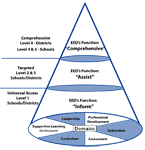
This two part rubric and worksheet is for use by individuals responsible for monitoring (1) district-level capacity to support response to intervention (RTI implementation and (2) district-wide fidelity of RTI implementation.
Reading Resources
Intensive Interventions for Students Struggling in Reading and Mathematics -Practice Guide
 This guide provides research-based guidance that reflects "best practices" for intensifying instruction in reading and mathematics for students with significant learning difficulties in K-12, including students with disabilities. It can also be used as a resource for instructional specialists and special education teachers who are searching for broad guidelines on the design and delivery of intensive interventions.
Improving K-3 Reading Comprehension
The Center on Instruction has published a series of four Improving K-3 Reading Comprehension professional development modules designed to provide key principles and practices that support classroom instruction. Each module provides resources useful to federally funded School Improvement Grant (SIG) programs. The webinar modules introduce the Center on Instruction (COI) and Doing What Works (DWW) websites' tools and resources and address 1) the supporting research, 2) teaching comprehension strategies, 3) engaging students with text, and 5).....
Webinar: Writing and Writing Instruction Improve Reading: What We Have Learned from Research
The Center on Instruction hosted a webinar on April 21, 2011, featuring Dr. Steve Graham, co-author of "Writing to Read", a meta-analysis that examines the influence of writing on reading skills. He presented an overview of the findings and described implications for practice. He also provided specific examples of how writing facilitates reading and reading development. The archived WebEx file can be accessed here. The PowerPoint presentation used during the webinar and a synopsis of the report is available for download below, and the full.....
COI Webinar Series: Using DWW Resources to Support SIG Grantees in Adolescent Literacy
The Center on Instruction has released a series of five webinar modules designed to provide key adolescent literacy principles and practices to support the federally funded School Improvement Grants (SIG). The webinar modules introduce the Center on Instruction (COI) and Doing What Works (DWW) websites' tools and resources and address 1) school leadership, 2) research overview, 3) explicit vocabulary instruction in middle and high school, 4) text discussion, and 5) intensive interventions for struggling readers. Also included for each module.....
Synopsis of "Writing to Read: Evidence for How Writing Can Improve Reading"
This synopsis of Graham and Hebert's meta-analysis presents an overview of their findings and describes implications for practice. It is intended to serve as a first step that will encourage further exploration of the "Writing to Read" document. The authors describe a range of instructional practices that have demonstrated a positive effect on reading outcomes and provide guidance on how teachers can use writing instruction to strengthen students' reading performance.
This resource pertains to the following categories:
Literacy.....
A Comprehensive K-3 Reading Assessment Plan: Guidance for School Leaders (COI)
Because scientific studies have repeatedly demonstrated the value of regularly assessing reading progress, a comprehensive assessment plan is a critical element of an effective school-level plan for preventing reading difficulties. This guide from the Center on Instruction provides valuable information for school leaders. While the general principles, such as the early identification of students who are struggling in learning to read, are all based on scientific findings, the detailed recommendations for implementation derive from practical.....
What Are Rural Districts Doing? (Ideas for rural districts and others considering or committed to using SIG Funds)
In order to help districts considering or committed to using School Improvement Grant funds to rapidly improve persistently low-performing schools, CII researchers searched websites of major cities and districts to discover tools and processes already in use. The results, while not exhaustive, may provide models for implementing turnarounds, restarts, school closure, or transformations.
Response to Intervention in Primary Grade Reading
Response to Intervention (RTI) in Primary Grade Reading is one of four sections within the newly added Data-Driven Improvement area on the Doing What Works website. The section is divided into four sub-sections: Universal Screening, Progress Monitoring and Differentiation, Systematic Skill Instruction, and Response to Intervention. Each sub-section contains a practice summary along with practical help in three tabs: Learn What Works (video interviews with nationally known research experts, key concepts, research evidence, and related links),.....
Improving Reading Comprehension in Kindergarten through 3rd Grade
This guide, developed by a panel of experts, presents a set of evidence-based practices that teachers and other educators can use to successfully teach reading comprehension to young readers. The panel review indicates that students who read with understanding at an early age gain access to a broader range of texts, knowledge, and educational opportunities, making early reader comprehension instruction particularly critical. The guide also describes the evidence that supports the practices and gives examples of how they can be implemented in.....
NEW Practice Guides
The What Works Clearinghouse has issued two new practice guides, with practical recommendations for educators to help them address the challenges they face in their classrooms and schools. “Improving Reading Comprehension in Kindergarten Through Third-Grade” recommends five specific steps that teachers, reading coaches, and principals can take to improve reading comprehension for young readers: teach students how to use reading comprehension strategies; teach students to identify and use the text’s organizational structure to.....
Adolescent Literacy Walk-through for Principals: A Guide for Instructional Leaders - Grades 4-12 (COI)
This guide and accompanying scenarios of adolescent literacy instruction from the Center on Instruction, designed to help principals monitor and support adolescent literacy instruction in their schools more effectively, can be used at the late elementary school level, in content-area classes in middle and high school, and with intervention groups or classes. It provides a scaffold to build principals' understanding of scientifically based reading instruction, as a means for a principal to gather information about the quality of literacy and.....
Bringing Literacy Strategies into Content Instruction
This document provides research-based guidance on academic literacy instruction in the content areas, specifically focusing on the effective use of text in content areas. It reviews the research evidence about content-area literacy instruction for adolescents and suggests ways teachers can use content-area texts to enable students to understand the vocabulary and concepts they contain. This document also provides a brief synopsis of working with adult learners and the most promising professional development practices identified in research......
Improving Adolescent Literacy: Effective Classroom and Intervention Practices
For the purposes of this website, these recommendations have been merged into four practices: Vocabulary Instruction; Comprehension Strategies; Engaging Text Discussion; and Intensive Intervention. This Practice Guide was developed by an expert panel convened by the Institute of Education Sciences. It is designed to address challenges in improving literacy levels in middle and high school and providing interventions for struggling adolescent readers. The Practice Guide offers a set of five research-based recommendations. A summary of the.....
How the EBIS/RTI Process Works in Secondary Schools
This document developed by the Tigard-Tualatin School District in Tigard, OR includes information on EBIS (Effective Behavior and Instructional Support) as a structured, systematic process (1) to review school-wide behavior and academic data in order to evaluate the effectiveness of core programs, (2) to screen and identify students needing additional academic and/or behavior support, and (3) to plan, implement, and modify interventions for these students. The document can be downloaded below, or you can click here for more information.
Instructional Models and Strategies for Teaching English Language Learners [K-12]
This publication offers educators and policy-makers guidance on research-based strategies that have been effective in instructing English Language learners (ELLs). Regardless of the model that school districts select, teachers--especially those who have not been trained to work with ELLs--need help to determine the most effective strategies to accelerate student learning and maximize instructional time. This document outlines key contextual factors that decision-makers should take into account when making instructional choices for ELLs,.....
Literacy Instruction in the Content Areas: Getting to the Core of Middle and High School Improvement
This report from the Alliance for Excellent Education (2007) contends that content teachers at the middle and secondary levels should engage their students in literacy training through integrated reading and writing activities that teach students how to recognize the particular conventions specific to the different subjects. The report concludes with practical policy goals to foster a greater integration of literacy training and content matter.
Effective Strategies That Boost Reading Comprehension
This multimedia overview highlights key research findings and specific practice implications for comprehension strategy instruction. (5:26 min)
Big Ideas in Beginning Reading
This website is designed to provide information, technology, and resources to teachers, administrators, and parents across the country.
Big Ideas in Beginning Reading focuses on the five BIG IDEAS of early literacy:
* Phonemic Awareness
* Alphabetic Principle
* Accuracy and Fluency with text
* Vocabulary
* Comprehension
The website includes definitions and descriptions of the research and theories behind each of the big ideas, describes how to assess the big ideas, and provides information on how to teach the.....